No tours available yet...
No tours available yet...
No tours available yet...


Adventure Vacations
for Couples

European Tours
for Seniors

European Tours
for Families

Group Tours to
Europe

Honeymoon
Europe Tour

Singles Tours
Europe
Alsace Wine Route
Bordeaux
Brittany
Burgundy
Canal du Midi
Champagne
Corsica
Dordogne
Loire Valley
French Riviera
Provence
Normandy
Paris
Pays Basque
Pyrenees
South France
France Castles
Massif Central
Northern France
Prehistoric Caves
WW2 Tours
Alps
Guadeloupe
Belgium
Portugal
Italy
Scotland
Tuscany
Holland
Ireland
Croatia
Switzerland
United Kingdom
Sardinia
Sicily
Puglia
Catalonia
Northern Spain
Atlantic Coast
Baltic States
Nordic States
France Bike Tours
Europe Bike Tours
Europe Luxury Bike Tours
Sunshine Bike Tours
Epic Cycling
Cycling Challenges
Italy
Spain
Holland
United Kingdom
Portugal
Ireland
Switzerland
Croatia
Provence
Loire Valley
Bordeaux
Brittany
Burgundy
Dordogne
Alsace
Massif Central
Italy
Spain
Portugal
Provence
Loire Valley
Bordeaux
Dordogne
Burgundy
Brittany
Alsace
Burgundy
Alsace
Bordeaux
Bordeaux
Burgundy
Alsace
Provence
Loire Valley
Languedoc
Portugal
Provence
Alsace
Dordogne
Loire Valley
Brittany
Burgundy
Normandy
Corsica
Provence
Normandy
Dordogne
Loire Valley
Burgundy
Alsace
Brittany
Corsica
Loire Valley
Provence
Bordeaux
Languedoc
Dordogne
Burgundy
Brittany
Guadeloupe
Loire Valley
Dordogne
Brittany
Provence
French Riviera
Spain
Normandy
Corsica
Atlantic Coast
Loire Valley
Dordogne
Brittany
Provence
French Riviera
Spain
Normandy
Corsica
Atlantic Coast
Provence
Loire Valley
Languedoc
Dordogne
Provence
Loire Valley
Languedoc
Dordogne
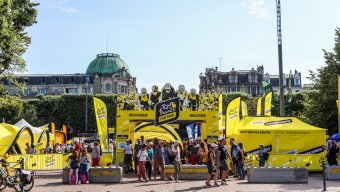
Discover the Tour de France from the inside with an exclusive VIP journey through the enchanting regions of Alsace and the Jura. From your welcome in...
 4 Days / 3 Nights
 Alsace
 From 16 July to 19 July 2026
 From 2790€
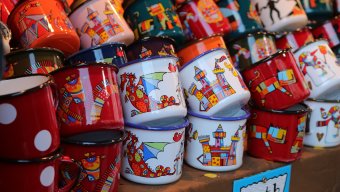
Embark on a whimsical walking tour through the charming villages of Alsace and the famous Christmas Markets. Along your journey you will explore...
7 Days / 6 Nights
Alsace
This tour starts on December 04th 2025 & finish on December 10th 2025.
From 2092€
 or
or
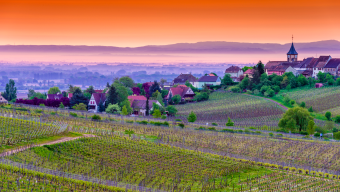
Immerse yourself in the elegance of Alsace , where refinement meets tradition at every turn. Nestled between the majestic Vosges Mountains and the...
7 Days / 6 Nights
Alsace
This tour starts any day of the year.
From 4644€
 or
or
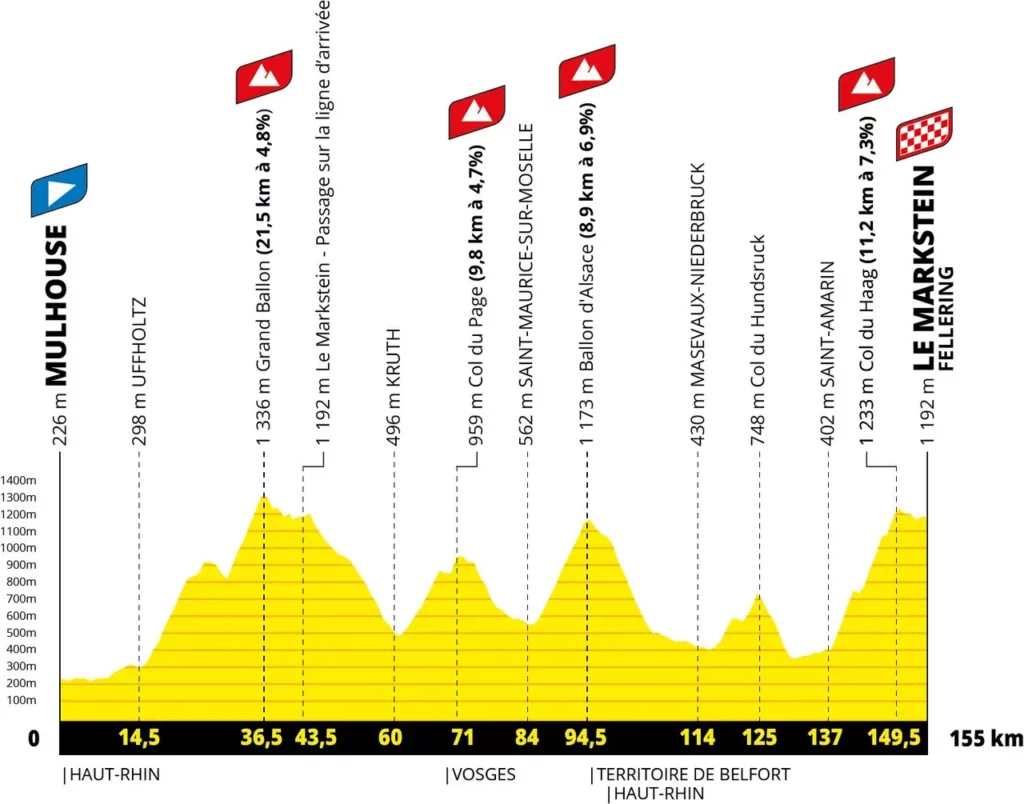 For travelers and fans following the Tour through eastern France, this is a rare opportunity to witness pure mountain drama set in one of the country’s most underappreciated regions for cycling: the Vosges. Quiet roads, wild forests, sharp gradients, and roaring crowds — stage 14 has it all.
| Category | Details |
|---|---|
| Stage number | 14 |
| Date | Saturday, July 18, 2026 |
| Start | Mulhouse (Haut-Rhin) |
| Finish | Le Markstein |
| Distance | 155 km |
| Total climbing | 3,800 m+ |
| Stage type | Mountain stage in the Vosges |
Mulhouse returns to the Tour de France for the 18th time, and it wastes no time challenging the peloton. Within minutes of the start, riders will hit the lower slopes of the Grand Ballon via Uffholtz. At 21.5 kilometers long with a 4.8 percent average, it is not the steepest climb — but as the first col of the day, it ensures early tension and makes for a brutal warm-up.
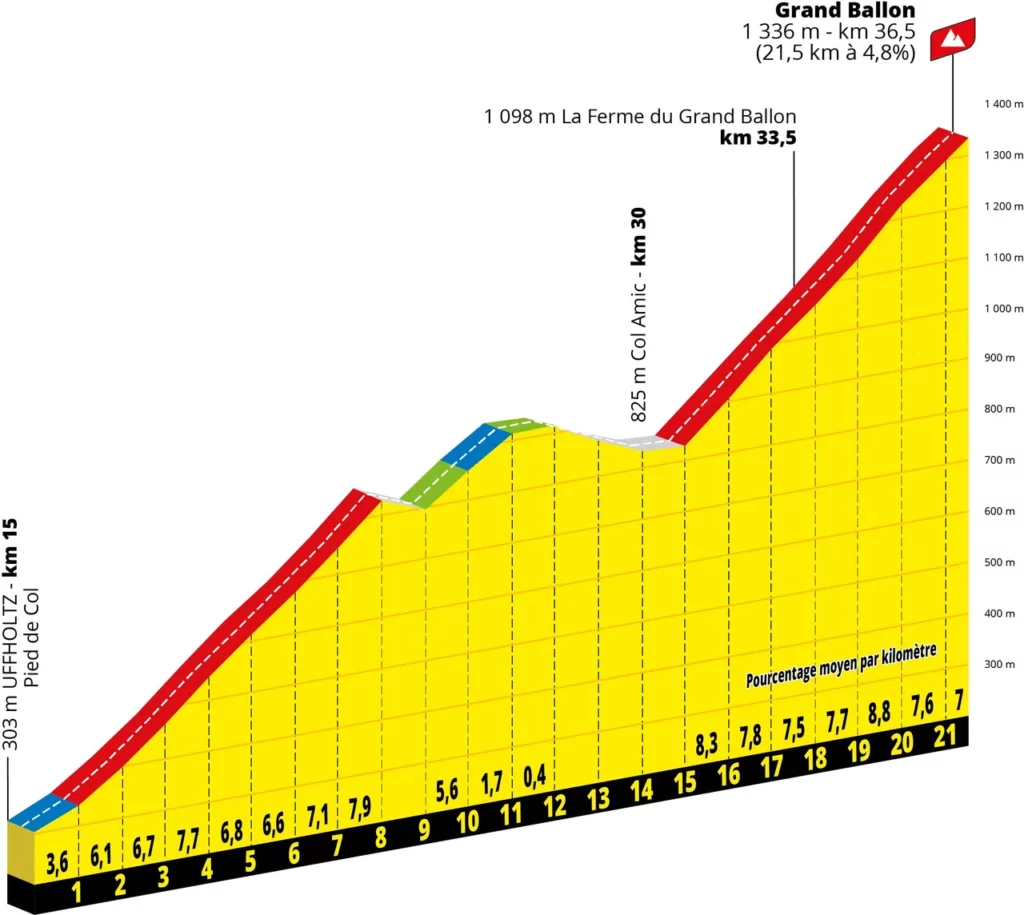
This early effort will test team strategies. Should a breakaway form here, it will likely contain strong climbers, not opportunists. With such a stacked climbing menu to follow, only serious legs will survive the day.
| Climb | Length | Average gradient | Notes |
|---|---|---|---|
| Grand Ballon | 21.5 km | 4.8% | Progressive ascent, opens the stage |
| Col du Page | 9.8 km | 4.7% | Ideal for rhythm; suits tempo climbers |
| Ballon d’Alsace | 8.9 km | 6.9% | Historic Tour climb with steep ramps |
| Col du Haag | 11.2 km | 7.3% | New to the Tour; narrow, wild, unpredictable |
| Le Markstein (final) | 6 km | Approx. 5% | Final push after exhausting sequence |
While many climbs on this stage are familiar, the Col du Haag is a new and terrifying addition. Hidden deep in the forest above Saint-Amarin, this 11.2 km ascent averages 7.3 percent, with savage pitches reaching 15 percent. The road is narrow, irregular, and almost never flat — a pure climber’s playground and a director sportif’s nightmare.
With the summit just six kilometers before the final run to the finish, the Col du Haag could explode the race. Riders who go into the red here may not recover in time for the final ascent. Conversely, a decisive attack could create critical gaps before the final showdown at Le Markstein.
Le Markstein is no stranger to Tour drama. In 2023, it was the backdrop for a legendary duel between Pogačar and Vingegaard. This time, riders will tackle it twice — once mid-stage, then again as the final summit finish. The second approach, after a full day of climbing, promises to be decisive.
The climb itself is not excessively steep, but context is everything. After hours of effort and with tired legs, the final six kilometers to the finish could be brutal. With wide-open roads and alpine winds sweeping across the ridgeline, the scene is set for a mano-a-mano battle between the yellow jersey contenders.
With only one rest day and one full mountain week remaining after this stage, stage 14 offers a rare early opportunity for GC riders to test each other. The density of climbs and the unpredictable nature of the Col du Haag mean that no one can hide. One bad moment could lead to minutes lost, while a brave move could lead to a Tour-defining gain.
Teams with strong mountain domestiques will be crucial early on, but in the final 10 kilometers, it will be every leader for themselves. The best climbers will rise. The vulnerable may fall out of contention entirely.
Beyond the race itself, stage 14 is also a celebration of the Vosges. Often overshadowed by the Alps or Pyrenees, this mid-mountain range offers equally thrilling climbs, dense forests, and stunning panoramas. Towns like Saint-Amarin and Saint-Maurice-sur-Moselle bring local charm, and the entire region is a dreamland for cyclists seeking quieter, challenging roads.
For cycling tourists, following this route means combining heritage with sport — from Mulhouse’s industrial history to the high-altitude landscapes of Le Markstein. Whether you’re chasing KOMs or just soaking in the view, this part of France delivers.
It is a brand-new climb on the Tour, with narrow roads, irregular gradients, and extreme pitches. Its position close to the finish makes it a tactical turning point.
Unlikely. The continuous climbing and importance for the GC battle mean the favorites will keep tight control of the race. Breakaway riders will struggle to stay clear.
While not as long or high, it is extremely demanding due to cumulative fatigue. Its exposure to wind and open terrain adds another layer of difficulty.
The Vosges combine steep, scenic climbs with quieter roads and rich local culture. It is ideal for riders seeking alpine-style challenges without the crowds.
Definitely. The upper slopes of the Markstein are exposed to wind, rain, and sudden changes. Météo will play a big role, especially in the final hour of racing.











 France Bike Tours
 Europe Bike Tours
 Europe Luxury Bike Tours
 Sunshine Tours
 Epic Cycling