No tours available yet...
No tours available yet...
No tours available yet...




Adventure Vacations
for Couples

European Tours
for Seniors

European Tours
for Families

Group Tours to
Europe

Honeymoon
Europe Tour

Singles Tours
Europe
Alsace Wine Route
Bordeaux
Brittany
Burgundy
Canal du Midi
Champagne
Corsica
Dordogne
Loire Valley
French Riviera
Provence
Normandy
Paris
Pays Basque
Pyrenees
South France
France Castles
Massif Central
Northern France
Prehistoric Caves
WW2 Tours
Alps
Guadeloupe
Belgium
Portugal
Italy
Scotland
Tuscany
Holland
Ireland
Croatia
Switzerland
United Kingdom
Sardinia
Sicily
Puglia
Catalonia
Northern Spain
Atlantic Coast
Baltic States
Nordic States
France Bike Tours
Europe Bike Tours
Europe Luxury Bike Tours
Sunshine Bike Tours
Epic Cycling
Cycling Challenges
Italy
Spain
Holland
United Kingdom
Portugal
Ireland
Switzerland
Croatia
Provence
Loire Valley
Bordeaux
Brittany
Burgundy
Dordogne
Alsace
Massif Central
Italy
Spain
Portugal
Provence
Loire Valley
Bordeaux
Dordogne
Burgundy
Brittany
Alsace
Burgundy
Alsace
Bordeaux
Bordeaux
Burgundy
Alsace
Provence
Loire Valley
Languedoc
Portugal
Provence
Alsace
Dordogne
Loire Valley
Brittany
Burgundy
Normandy
Corsica
Provence
Normandy
Dordogne
Loire Valley
Burgundy
Alsace
Brittany
Corsica
Loire Valley
Provence
Bordeaux
Languedoc
Dordogne
Burgundy
Brittany
Guadeloupe
Loire Valley
Dordogne
Brittany
Provence
French Riviera
Spain
Normandy
Corsica
Atlantic Coast
Loire Valley
Dordogne
Brittany
Provence
French Riviera
Spain
Normandy
Corsica
Atlantic Coast
Provence
Loire Valley
Languedoc
Dordogne
Provence
Loire Valley
Languedoc
Dordogne

This VIP guided tour immerses you in the heart of the Alps, renowned for breathtaking scenery and legendary climbs. While the final route is yet to be...
 8 Days / 7 Nights
 Alps
Alps
 From 19 to 26 July 2026
 From 6900€
 or
or

Experience the Tour de France like never before with a luxury VIP journey from the majestic Alps to the iconic Champs-Élysées. Begin in Lyon with a...
5 Days / 4 Nights
Alps
From 23 July to 27 July 2026
From 4090€

L'Etape du Tour de France 2026 will take place on July 19th 2026. The route is Bourg d'Oisans to l'Alpe d'Huez. Live the legend of the Tour de France,...
1 Days / 0 Nights
Alps
L'Etape du Tour de France 2026 will take place on July 19th 2026.
From 280€
For readers of discoverfrance.com, this is not only a decisive sporting chapter but also one of the most symbolic cycling routes in Europe. Few climbs carry the emotional weight of Alpe d Huez. Few stages are designed so clearly to provoke attacks from the very first hour.
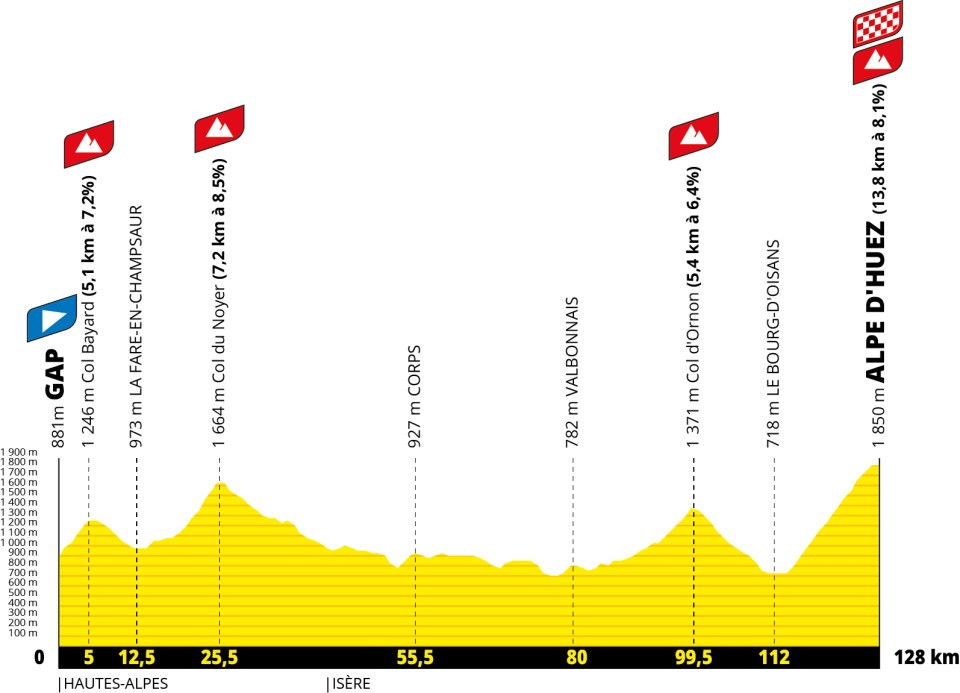
The structure of Tour de France 2026 Stage 19 Gap Alpe d Huez sends a clear message to the peloton. There will be no hiding.
| Category | Details |
|---|---|
| Date | July 24 2026 |
| Distance | 128 km |
| Start | Gap Hautes Alpes |
| Finish | Alpe d Huez Isere |
| Main Climbs | Col Bayard Col du Noyer Col d Ornon Alpe d Huez |
| Final Ascent | Alpe d Huez 13.8 km at 8.1 percent |










 France Bike Tours
 Europe Bike Tours
 Europe Luxury Bike Tours
 Sunshine Tours
 Epic Cycling